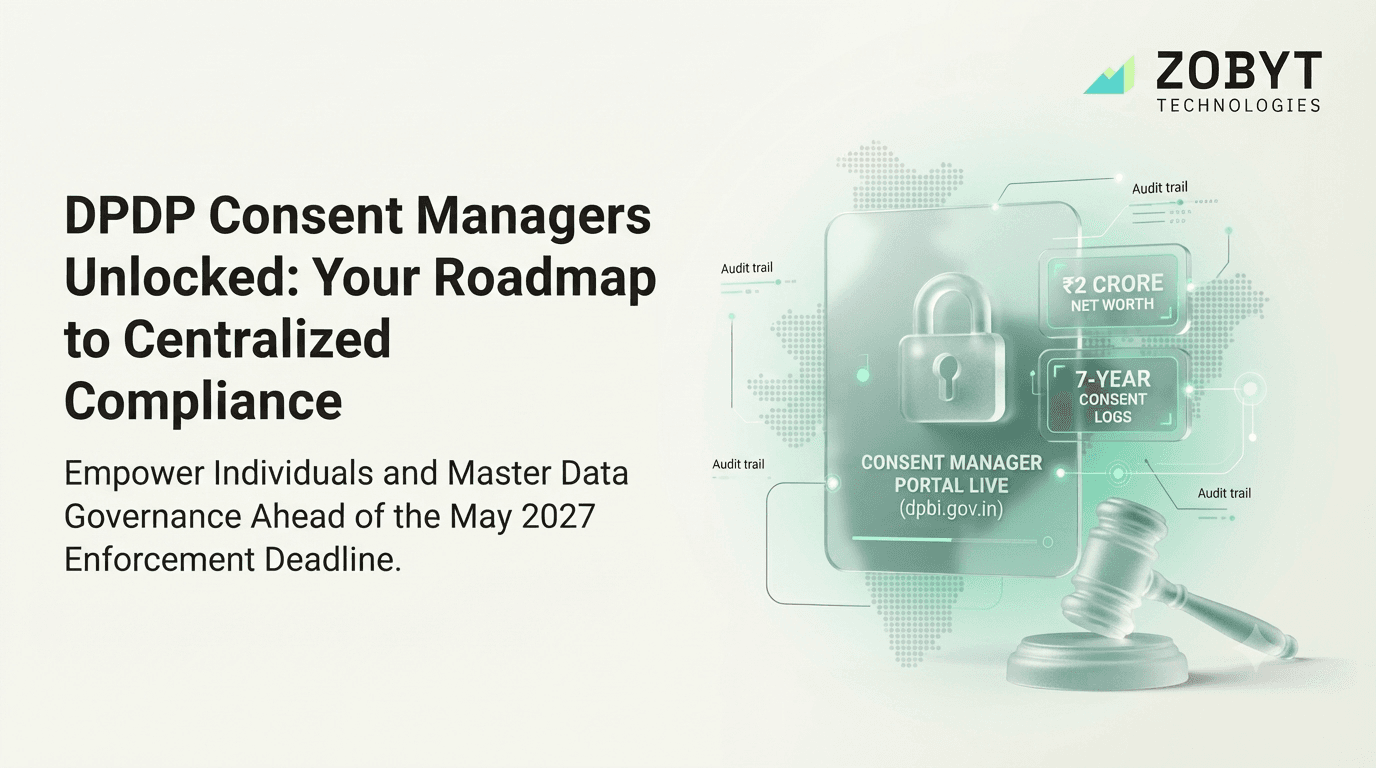
DPDP Consent Manager Framework Explained
Summary
With the Consent Manager portal live on dpbi.gov.in under Rule 4 of the DPDP Rules, 2025, this guide explains how Consent Managers work, the ₹2 crore net worth and data-blind rules, and what Data Fiduciaries and Data Processors must build before May 13, 2027. Plus, how Zobyt Technologies helps automate compliance.
Article
India took a major step toward citizen-controlled data privacy on November 13, 2026, when the Ministry of Electronics and Information Technology (MeitY) operationalized the Consent Manager registration framework under the Digital Personal Data Protection (DPDP) Act, 2023 and Rule 4 of the DPDP Rules, 2025. Alongside the launch of the online registration portal at dpbi.gov.in, eligible Indian companies can now apply to become registered Consent Managers.
If you are building a privacy tech platform, running a consumer app, or managing enterprise compliance ahead of the May 13, 2027, full enforcement deadline, here is what the Consent Manager framework means for you in plain terms.
What is a Consent Manager under the DPDP Act?
Under Section 2(g) of the DPDP Act, 2023, a Consent Manager is a registered entity that acts as a single, accessible, transparent, and interoperable point of contact for individuals (Data Principals).
Instead of remembering which apps, websites, or financial services hold their permissions across dozens of separate dashboards, a user can give, manage, review, and withdraw consent through a Consent Manager platform. In practice, it works similarly to how India’s Account Aggregator model standardizes permissioned financial sharing. Except, it is designed around consent lifecycles for digital personal data.
Who qualifies? ₹2 Crore net worth threshold and essential regulatory rules
To register with the Data Protection Board of India (DPBI), an applicant must satisfy strict eligibility rules and ongoing operating duties set out in Rule 4 and the First Schedule (Parts A and B) of the DPDP Rules, 2025:
Key takeaways from Part A and Part B of the first schedule include:
- Indian company only: Only a company incorporated in India (under the Companies Act, 2013) can apply, sole proprietors, partnerships, LLPs, and foreign entities do not qualify.
- ₹2 Crore minimum net worth: The company must hold a net worth of at least ₹2 crore, backed by financial capacity, sound management, and a viable business and capital plan.
- "Data Blind" architecture: A Consent Manager cannot read the contents of personal data shared through its platform; it facilitates consent and permission workflows without inspecting the underlying personal data.
- 7-Year audit trail: It must maintain records of consents given, denied, or withdrawn, notices presented, and data shared with Data Fiduciaries for at least seven years, and make that record available to the individual (including in machine-readable form upon request).
- Fiduciary duty & no sub-contracting: A Consent Manager acts in a fiduciary capacity toward the Data Principal, must avoid conflicts of interest with connected Data Fiduciaries, cannot sub-contract or assign its core obligations, and requires prior Board approval before any change of control.
How registration works in practice
The online portal at dpbi.gov.in gives aspiring Consent Managers a structured path to apply:
- Check eligibility & governance terms: Confirm incorporation in India, the ₹2 crore net worth threshold, technical/security readiness, and required conflict-of-interest and governance provisions in the company’s charter documents.
- Prepare required documentation: Assemble corporate records, CA-certified net worth/financial documents, system architecture details showing data-blindness and security controls, governance policies, and key management declarations.
- Submit online & await board review: File the application on
dpbi.gov.in. Under Rule 4(2), the Data Protection Board of India can conduct inquiries it considers appropriate before registering an applicant (and publishing registered particulars on its website) or issuing a reasoned rejection.
Practical Timing Note: While applications can be submitted on dpbi.gov.in, final Board decisions and public listings of registered Consent Managers depend on the Board’s operational proceedings and Member appointments. Treat this window as the time to architect your systems rather than waiting until the last minute.Do businesses have to register or use a Consent Manager?
A common point of confusion in November 2026 is whether ordinary companies must register as Consent Managers or force users through one. The rules draw a clear line by role:
- If you are an everyday business (Data Fiduciary): You do not need to register as a Consent Manager just to collect customer or user data for your own products or services, and using a Consent Manager is not mandatory as your sole consent channel. However, individuals have the statutory right to give, manage, or withdraw consent through a registered Consent Manager under Section 6(7); so your consent architecture should be built to honor those signals when full substantive enforcement arrives on May 13, 2027.
- If you are a vendor / SaaS Tool (Data Processor): You process data on behalf of Data Fiduciaries and will need APIs, webhooks, and deletion/audit capabilities that help your business clients honor consent updates and data rights cleanly.
———————————————————————————————————————————————————————————
Turn consent & data workflows into automated systems with Zobyt
Preparing for May 13, 2027, is not just about updating static legal text, it is about wiring consent states, data discovery, retention schedules, and audit logs directly into how your software and vendors operate.
At Zobyt Technologies, we build tailored DPDP automation systems around your specific business workflows covering-
- Consent lifecycles
- Data discovery
- Data Principal rights
- Retention/deletion schedules
- Breach/audit logging
A solution that works across your apps and vendors.
Reach out to our team at discuss@zobyt.com to get started and watch for the rest of our DPDP Act series on how to keep your business safe.
Related Posts
- DPDP Act & Rules 2025: Complete timeline and plan (Blog Post)
- A comprehensive guide on starting a data center in India (Blog Post)
- What happens when AI judges content and people bet on it? (Blog Post)
- Political funding token: Designing a transparent yet private donation system on blockchain (Blog Post)